
Vecteurs et coordonnées
Définition
Un repère du plan est déterminé par un point quelconque O, appelé origine du repère, et deux vecteurs $\vec{i}$ et $\vec{j}$ non colinéaires.
Définition
On dit que le repère $\left(O;\vec{i},\vec{j}\right)$ est :
- orthogonal : si les vecteurs $\vec{i}$ et $\vec{j}$ sont orthogonaux
- orthonormé ou orthonormal : si le repère est orthogonal et si les vecteurs $\vec{i}$ et $\vec{j}$ ont la même norme.
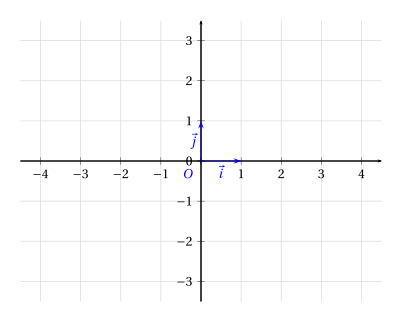
Repère orthonormé
Définition
Soit $\left(O;\vec{i},\vec{j}\right)$ un repère du plan.
On dit que $M$ a pour coordonnées $\left(x ; y\right)$ si et seulement si :
$\overrightarrow{OM}=x\vec{i}+y\vec{j}$
On dit que $\vec{u}$ a pour coordonnées $\begin{pmatrix} x \\ y \end{pmatrix}$ si et seulement si :
$\vec{u}=x\vec{i}+y\vec{j}$
Par la suite, on considère que le plan P est muni d’un repère $\left(O;\vec{i},\vec{j}\right)$.
Propriété
Deux vecteurs $\vec{u}$ et $\vec{v}$ sont égaux si et seulement si ils ont les mêmes coordonnées.
Propriété
Soient $A\left(x_A;y_A\right)$ et $B\left(x_B;y_B\right)$. Le vecteur $\overrightarrow{AB}$ a pour coordonnées $\begin{pmatrix} x_B – x_A \\ y_B – y_A \end{pmatrix}$
Exemple
Soient $A\left(1 ; 1\right), B\left(4 ; 2\right), C\left(5 ; 0\right), D\left(2 ; – 1\right)$
Les coordonnées de $\overrightarrow{AB}$ sont $\begin{pmatrix} 4 – 1 \\ 2 – 1 \end{pmatrix} = \begin{pmatrix} 3 \\ 1 \end{pmatrix}$
Les coordonnées de $\overrightarrow{DC}$ sont $\begin{pmatrix} 5 – 2 \\ 0 – \left( – 1\right) \end{pmatrix} = \begin{pmatrix} 3 \\ 1 \end{pmatrix}$
$\overrightarrow{AB} = \overrightarrow{DC}$ donc $ABCD$ est un parallélogramme. ( voir Généralités sur les vecteurs )
Propriété
Soient deux vecteurs $\vec{u} \begin{pmatrix} x \\ y \end{pmatrix}$ et $\vec{v} \begin{pmatrix} x^{\prime} \\ y^{\prime} \end{pmatrix}$.
- Le vecteur $\vec{u}+\vec{v}$ a pour coordonnées $\begin{pmatrix} x+x^{\prime} \\ y+y^{\prime} \end{pmatrix}$
- Le vecteur $k\vec{u}$ a pour coordonnées $\begin{pmatrix} kx \\ ky \end{pmatrix}$
Propriété
Colinéarité
Deux vecteurs non nuls $\vec{u} \begin{pmatrix} x \\ y \end{pmatrix}$ et $\vec{v} \begin{pmatrix} x^{\prime} \\ y^{\prime} \end{pmatrix}$ sont colinéaires si et seulement si:
$xy^{\prime} – yx^{\prime}=0$
Propriété
Milieu d’un segment
Si $A\left(x_A;y_A\right)$ et $B\left(x_B;y_B\right)$, le milieu $M$ de $\left[AB\right]$ a pour coordonnées :
$M \left(\dfrac{x_A+x_B}{2} ; \dfrac{y_A+y_B}{2}\right)$
Propriété
Norme et distance
Soit un vecteur $\vec{u} \begin{pmatrix} x \\ y \end{pmatrix}$. Alors :
$||\vec{u}||=\sqrt{x^2+y^2}$
On en déduit si $A\left(x_A;y_A\right)$ et $B\left(x_B;y_B\right)$ :
$AB=||\overrightarrow{AB}||=\sqrt{\left(x_B – x_A\right)^2+\left(y_B – y_A\right)^2}$
Exemple
Soient $A\left(1 ; 0\right), B\left(3 ; 1\right), C\left(0 ; 2\right)$.
Que peut-on dire du triangle $ABC$ ?
$AB=\sqrt{2^2+1^2}=\sqrt{5}$
$AC=\sqrt{\left( – 1\right)^2+2^2}=\sqrt{5}$
$BC=\sqrt{\left( – 3\right)^2+1^2}=\sqrt{10}$
Donc $AB=AC$
De plus :
$AB^2+AC^2=5+5=10$
$BC^2=10$
Le triangle $ABC$ est donc rectangle en $A$ (réciproque du théorème de Pythagore) et isocèle.