
Limites d’une fonction
1. Définitions
Définition
Limite infinie quand xxx tend vers l'infini.
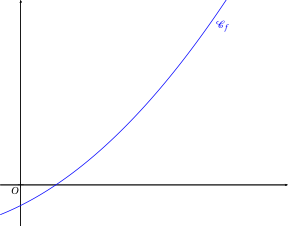
Soit $ f $ une fonction définie sur un intervalle $ \left[a; +\infty \right[ $.
On dit que que $ f\left(x\right) $ tend vers $ +\infty $ quand $ x $ tend vers $ +\infty $ lorsque pour $ x $ suffisamment grand, $ f\left(x\right) $ est aussi grand que l'on veut. On écrit alors que $ \lim\limits_{x\rightarrow +\infty } f\left(x\right)=+\infty $.
Remarque
On définit de façon similaire les limites :
$ \lim\limits_{x\rightarrow +\infty } f\left(x\right)= - \infty $ ; $ \lim\limits_{x\rightarrow - \infty } f\left(x\right)=+\infty $ ; $ \lim\limits_{x\rightarrow - \infty } f\left(x\right)= - \infty $.
Définition
Limite finie quand xxx tend vers l'infini.
Soit $ f $ une fonction définie sur un intervalle $ \left[a ; +\infty \right[ $.
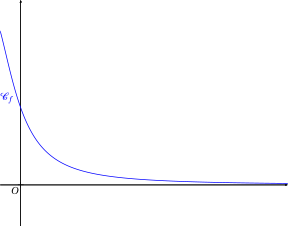
On dit que que $ f\left(x\right) $ tend vers $ l $ quand $ x $ tend vers $ +\infty $ lorsque pour $ x $ suffisamment grand, $ f\left(x\right) $ est aussi proche de $ l $ que l'on veut. On écrit alors que $ \lim\limits_{x\rightarrow +\infty } f\left(x\right)=l $.
Remarque
On définit de façon similaire la limite $ \lim\limits_{x\rightarrow - \infty } f\left(x\right)=l $.
Définition
Si $ \lim\limits_{x\rightarrow - \infty }f\left(x\right)=l $ ou $ \lim\limits_{x\rightarrow +\infty }f\left(x\right)=l $, on dit que la droite d'équation $ y=l $ est asymptote horizontale à la courbe représentative de la fonction $ f $.
Exemple
Sur la courbe ci-dessus, la droite d'équation $ y=0 $ est asymptote horizontale à la courbe représentative de $ f $.
Définition
Limite infinie quand xxx tend vers un réel.
Soit $ f $ une fonction définie sur un intervalle $ \left]a; b\right[ $ (avec $ a < b $).
On dit que que $ f\left(x\right) $ tend vers $ +\infty $ quand $ x $ tend vers $ a $ par valeurs supérieures lorsque $ f\left(x\right) $ est aussi grand que l'on veut quand $ x $ se rapproche de $ a $ en restant supérieur à $ a $. On écrit alors $ \lim\limits_{x\rightarrow a^+} f\left(x\right)=+\infty $ ou $ \lim\limits_{\scriptstyle x\rightarrow a \atop\scriptstyle x > a} f\left(x\right)=+\infty $.
De même, on dit que que $ f\left(x\right) $ tend vers $ +\infty $ quand $ x $ tend vers $ b $ par valeurs inférieures lorsque $ f\left(x\right) $ est aussi grand que l'on veut quand $ x $ se rapproche de $ b $ en restant inférieur à $ b $. On écrit alors $ \lim\limits_{x\rightarrow b^ - } f\left(x\right)=+\infty $ ou $ \lim\limits_{\scriptstyle x\rightarrow b \atop\scriptstyle x < b} f\left(x\right)=+\infty $.
Enfin, si $ c\in \left]a;b\right[ $ , on dit que que $ f\left(x\right) $ tend vers $ +\infty $ quand $ x $ tend vers $ c $ si $ f\left(x\right) $ tend vers $ +\infty $ quand $ x $ tend vers $ c $ par valeurs supérieures et par valeurs inférieures. On écrit alors $ \lim\limits_{x\rightarrow c} f\left(x\right)=+\infty $.
Remarque
On définit de façon symétrique $ \lim\limits_{x\rightarrow a^ - } f\left(x\right)= - \infty $, $ \lim\limits_{x\rightarrow a^+} f\left(x\right)= - \infty $ et $ \lim\limits_{x\rightarrow a} f\left(x\right)= - \infty $ en remplaçant «$f(x)$ est aussi grand que l'on veut » par « $f(x)$ est aussi petit que l'on veut » dans la définition.
Définition
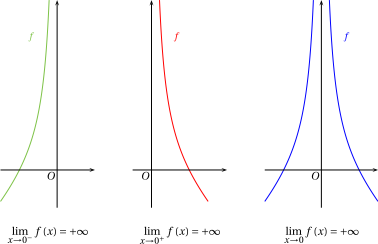
Si $ \lim\limits_{x\rightarrow c^ - }f\left(x\right)=\pm \infty $ ou $ \lim\limits_{x\rightarrow c^+}f\left(x\right)=\pm \infty $ ou $ \lim\limits_{x\rightarrow c}f\left(x\right)=\pm \infty $, on dit que la droite d'équation $ x=c $ est asymptote verticale à la courbe représentative de la fonction $ f $.
Exemple
Sur les trois courbes de la figure ci-dessous, la droite d'équation $ x=0 $ est asymptote verticale à la courbe représentative de $ f $.
Définition
Limite finie quand x tend vers un réel.
Soit $ f $ une fonction définie sur un intervalle $ \left]a;b\right[ $ (avec $ a < b $).
On dit que que $ f\left(x\right) $ tend vers $ l $ quand $ x $ tend vers $ a $ par valeurs supérieures lorsque $ f\left(x\right) $ se rapproche de $ l $ quand x se rapproche de $ a $ en restant supérieur à $ a $.
On écrit alors $ \lim\limits_{x\rightarrow a^+} f\left(x\right)=l $ ou $ \lim\limits_{\begin{matrix}x\rightarrow a \\ x > a\end{matrix}} f\left(x\right)=l $.
De même, on dit que que $ f\left(x\right) $ tend vers $ l $ quand $ x $ tend vers $ b $ par valeurs inférieures lorsque $ f\left(x\right) $ se rapproche de $ l $ quand x se rapproche de $ b $ en restant inférieur à $ b $.
On écrit alors $ \lim\limits_{x\rightarrow b^ - } f\left(x\right)=l $ ou $ \lim\limits_{\begin{matrix}x\rightarrow b \\ x < b\end{matrix}} f\left(x\right)=l $.
Enfin, si $ c\in \left]a; b\right[ $ , on dit que que $ f\left(x\right) $ tend vers $ l $ quand $ x $ tend vers $ c $ si $ f\left(x\right) $ tend vers $ l $ quand $ x $ tend vers $ c $ par valeurs supérieures et par valeurs inférieures.
On écrit alors $ \lim\limits_{x\rightarrow c} f\left(x\right)=l $.
2. Limites usuelles
Propriété
Pour tout entier $ n > 1 $ :
- $ \lim\limits_{x\rightarrow - \infty }x^{n}=\left\{ \begin{matrix} - \infty \text{ si n est impair} \\ +\infty \text{ si n est pair} \end{matrix}\right. $
- $ \lim\limits_{x\rightarrow +\infty }x^{n}=+\infty $
- $ \lim\limits_{x\rightarrow - \infty }\dfrac{1}{x^{n}}=0 $
- $ \lim\limits_{x\rightarrow +\infty }\dfrac{1}{x^{n}}=0 $
- $ \lim\limits_{x\rightarrow 0^ - }\dfrac{1}{x}= - \infty $
- $ \lim\limits_{x\rightarrow 0^+}\dfrac{1}{x}=+\infty $
- $ \lim\limits_{x\rightarrow +\infty }\sqrt{x}=+\infty $
- $ \lim\limits_{x\rightarrow +\infty }\text{e}^{x} =+\infty $
- $ \lim\limits_{x\rightarrow - \infty } \text{e}^{ x } = 0 $
3. Opérations sur les limites
Propriété
Limite d'une somme.
$ a $ désigne un réel ou $ +\infty $ ou $ - \infty $.
| $\lim\limits_{x\rightarrow a}f\left(x\right)$ | $\lim\limits_{x\rightarrow a}g\left(x\right)$ | $\lim\limits_{x\rightarrow a}f\left(x\right)+g\left(x\right)$ |
|---|---|---|
| $l$ | $l^{\prime}$ | $l+l^{\prime}$ |
| $l$ | $+\infty$ | $+\infty$ |
| $l$ | $- \infty$ | $- \infty$ |
| $+\infty$ | $+\infty$ | $+\infty$ |
| $- \infty$ | $- \infty$ | $- \infty$ |
| $+\infty$ | $- \infty$ | F.I. |
$ F.I. $ signifie forme indéterminée.
Remarque
« Forme indéterminée » ne signifie pas que la limite n'existe pas mais que les formules d'opérations sur les limites ne permettent pas de trouver directement limite. Pour la calculer, il faut alors « lever l'indétermination » par exemple en simplifiant une fraction (cf. fiches méthodes).
Propriété
Limite d'un produit.
$ a $ désigne un réel ou $ +\infty $ ou $ - \infty $.
| $\lim\limits_{x\rightarrow a}f\left(x\right)$ | $\lim\limits_{x\rightarrow a}g\left(x\right)$ | $\lim\limits_{x\rightarrow a}f\left(x\right)\times g\left(x\right)$ |
|---|---|---|
| $l$ | $l^{\prime}$ | $l\times l^{\prime}$ |
| $l\neq 0$ | $\pm \infty$ | $\left(signe\right)\infty$ |
| $\pm \infty$ | $\pm \infty$ | $\left(signe\right)\infty$ |
| $0$ | $\pm \infty$ | F.I. |
- $ F.I. $ signifie forme indéterminée.
- $ \pm \infty $ signifie que la formule s'applique pour $ +\infty $ et pour $ - \infty $.
- $ \left(signe\right)\infty $ signifie que l'on utilise la règle des signes usuelle :
$ +\times +=+ $
$ +\times - = - $
$ - \times - =+ $
pour déterminer si la limite vaut $ +\infty $ ou $ - \infty $.
Propriété
Limite d'un quotient.
$ a $ désigne un réel ou $ +\infty $ ou $ - \infty $.
| $\lim\limits_{x\rightarrow a}f\left(x\right)$ | $\lim\limits_{x\rightarrow a}g\left(x\right)$ | $\lim\limits_{x\rightarrow a}\dfrac{f\left(x\right)}{g\left(x\right)}$ |
|---|---|---|
| $l$ | $l^{\prime}\neq 0$ | $\dfrac{l}{l^{\prime}}$ |
| $l\neq 0$ | $0$ | $\left(signe\right)\infty$ |
| $0$ | $0$ | F.I. |
| $l$ | $\pm \infty$ | $0$ |
| $\pm \infty$ | $l$ | $\left(signe\right)\infty$ |
| $\pm \infty$ | $\pm \infty$ | F.I. |
Propriété
Limite d'une fonction composée.
$ a $, $ b $ et $ c $ désignent des réels ou $ +\infty $ ou $ - \infty $.
Si $ \lim\limits_{x\rightarrow a}f\left(x\right)=\color{red}{b} $ et $ \lim\limits_{x\rightarrow \color{red}{b}}g\left(x\right)=c $ alors :
$ \lim\limits_{x\rightarrow a}g\left(f\left(x\right)\right)=c $.
Remarque
On pose souvent $ X=f\left(x\right) $ («changement de variable») et on écrit alors :
$ \lim\limits_{x\rightarrow a}X=\lim\limits_{x\rightarrow a}f\left(x\right)=b $
$ \lim\limits_{x\rightarrow a}g\left(f\left(x\right)\right)=\lim\limits_{X\rightarrow b}g\left(X\right)=c $.
Exemple
On cherche à calculer :
$ \lim\limits_{x\rightarrow - \infty }\sqrt{1+x^{2}} $.
On pose $ X=1+x^{2} $. Alors :
$ \lim\limits_{x\rightarrow - \infty }X=\lim\limits_{x\rightarrow - \infty }1+x^{2}=+\infty $
et
$ \lim\limits_{x\rightarrow - \infty }\sqrt{1+x^{2}}=\lim\limits_{X\rightarrow +\infty }\sqrt{X}=+\infty $.
4. Théorèmes de comparaison
Théorème
- Si $ f\left(x\right)\geqslant g\left(x\right) $ sur un intervalle de la forme $ \left[a;+\infty \right[ $ et si $ \lim\limits_{x\rightarrow +\infty }g\left(x\right)=+\infty $ alors :
$ \lim\limits_{x\rightarrow +\infty }f\left(x\right)=+\infty $. - Si $ f\left(x\right)\leqslant g\left(x\right) $ sur un intervalle de la forme $ \left[a;+\infty \right[ $ et si $ \lim\limits_{x\rightarrow +\infty }g\left(x\right)= - \infty $ alors :
$ \lim\limits_{x\rightarrow +\infty }f\left(x\right)= - \infty $.
Théorème
Théorème des "gendarmes".
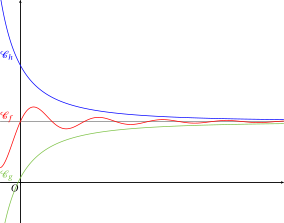
Si $ g\left(x\right)\leqslant f\left(x\right)\leqslant h\left(x\right) $ sur un intervalle de la forme $ \left[a;+\infty \right[ $ et si $ \lim\limits_{x\rightarrow +\infty }g\left(x\right)=\lim\limits_{x\rightarrow +\infty }h\left(x\right)=l $ alors :
$ \lim\limits_{x\rightarrow +\infty }f\left(x\right)=l. $
Théorème des gendarmes
Remarque
On a des théorèmes similaires lorsque $ x \rightarrow - \infty $.