Exercices
15 min
Non commencé
Limites fonction rationnelle
Soit la fonction $ f $ définie sur $ \left] - \infty ; - 1\right[ \cup \left] - 1 ; 1\right[ \cup \left]1 ; +\infty \right[ $ par :
$ f\left(x\right)=\dfrac{x+2}{x^{2} - 1} $
Déterminer les limites de $ f $ aux bornes de son ensemble de définition. (Il y a 6 limites à calculer)
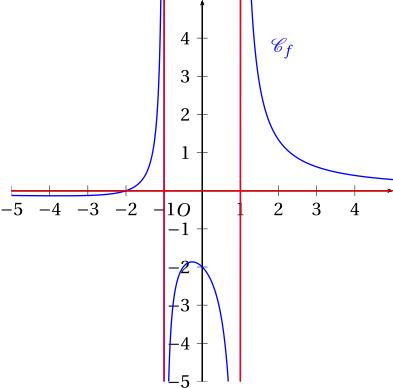
Quelles sont les asymptotes (horizontales et verticales) à la courbe représentative de $ f $ ?
Corrigé
- En $ +\infty $ et $ - \infty $ :
On a une forme indéterminée du type «$ \dfrac{\infty}{\infty} $» (voir Méthode : Formes indéterminées)
On factorise par $ x $ au numérateur et $ x^{2} $ au dénominateur :
$ f\left(x\right)=\dfrac{x\left(1+2/x\right)}{x^{2}\left(1 - 1/x^{2}\right)}=\dfrac{1+2/x}{x\left(1 - 1/x^{2}\right)} $
Lorsque $ x\rightarrow \backslash\pm \infty $ le numérateur tend vers 1 et le dénominateur tend vers $ \backslash\pm \infty $ donc :
$ \lim\limits_{x\rightarrow \backslash\pm \infty }f\left(x\right)=0 $
Remarque : On peut aussi écrire : $ \lim\limits_{x\rightarrow \backslash\pm \infty }\dfrac{x+2}{x^{2} - 1}=\lim\limits_{x\rightarrow \backslash\pm \infty }\dfrac{x}{x^{2}}=\lim\limits_{x\rightarrow \backslash\pm \infty }\dfrac{1}{x}=0 $ - En $ - 1 $ et $ +1 $
Le dénominateur tend vers zéro; on a une limite du type «$ \dfrac{k}{0} $» (voir Méthode : limite «$ k/0 $»)
On peut écrire $ f\left(x\right)=\dfrac{x+2}{\left(x - 1\right)\left(x+1\right)} $
Si $ x\rightarrow - 1 $ et $ x < - 1 $ :
$ x+2 > 0 $ (tend vers $ 1 $)
$ x - 1 < 0 $ (tend vers $ - 2 $)
$ x+1 < 0 $ (car $ x < - 1 $)
donc $ \lim\limits_{x\rightarrow - 1^ - }f\left(x\right)=+\infty $
Si $ x\rightarrow - 1 $ et $ x > - 1 $ :
$ x+2 > 0 $ (tend vers $ 1 $)
$ x - 1 < 0 $ (tend vers $ - 2 $)
$ x+1 > 0 $ (car $ x > - 1 $)
donc $ \lim\limits_{x\rightarrow - 1^+}f\left(x\right)= - \infty $
Si $ x\rightarrow 1 $ et $ x < 1 $ :
$ x+2 > 0 $ (tend vers $ 3 $)
$ x+1 > 0 $ (tend vers $ 2 $)
$ x - 1 < 0 $ (car $ x < 1 $)
donc $ \lim\limits_{x\rightarrow +1^ - }f\left(x\right)= - \infty $
Si $ x\rightarrow 1 $ et $ x > 1 $ :
$ x+2 > 0 $ (tend vers $ 3 $)
$ x+1 > 0 $ (tend vers $ 2 $)
$ x - 1 > 0 $ (car $ x > 1 $)
donc $ \lim\limits_{x\rightarrow +1^+}f\left(x\right)=+\infty $
La courbe représentative de $ f $ admet :
- une asymptote horizontale d'équation $ y=0 $
- deux asymptotes verticales d'équations $ x= - 1 $ et $ x=1 $